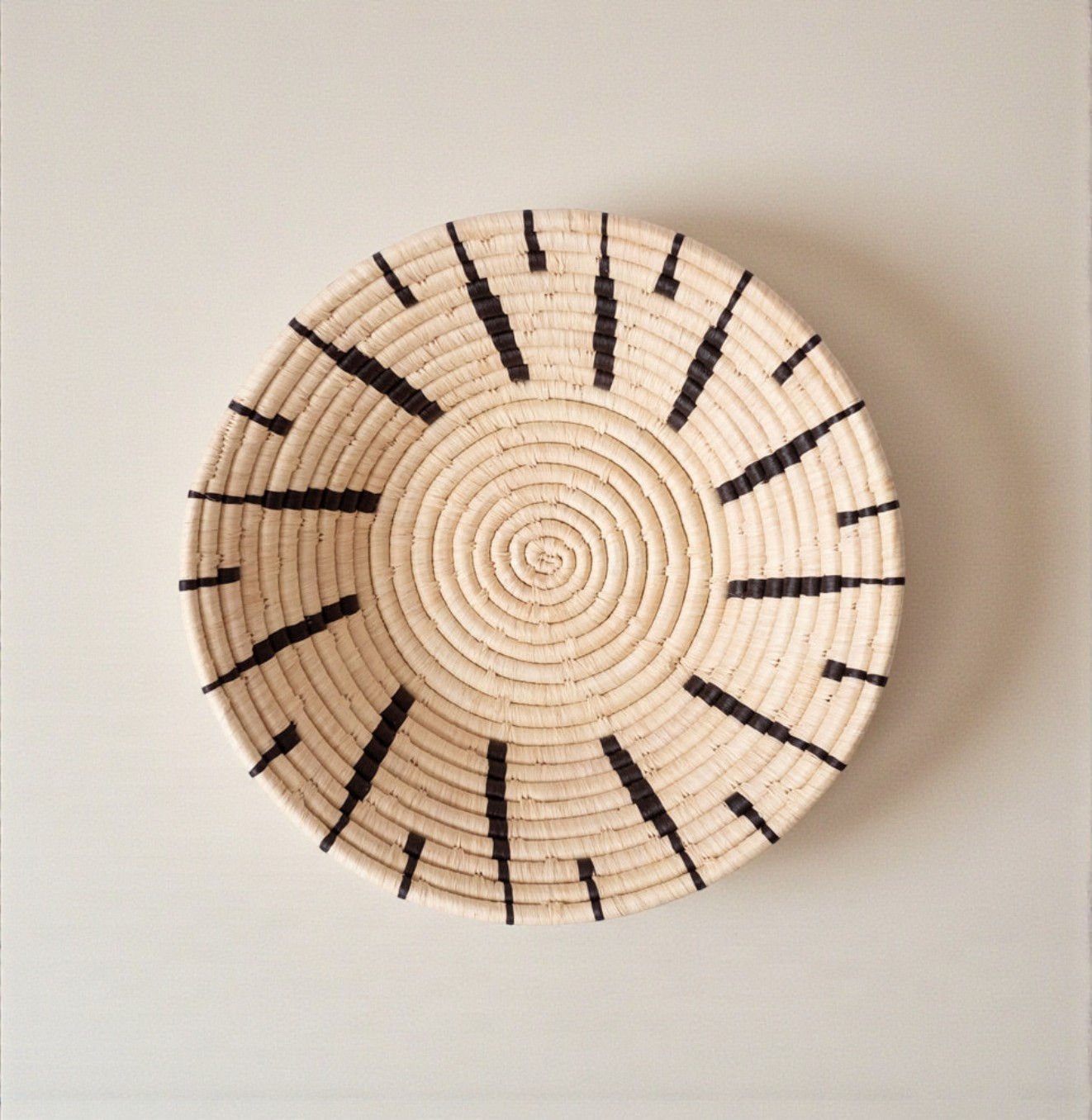

Thin Ray Basket
This is the kind of object that makes you reconsider how much meaning a basket is allowed to carry.
What It Is
The Thin Ray Basket is a handwoven wall or tabletop basket made from sustainably sourced raffia and banana fibers, crafted by women artisans in Central Uganda. Rendered in a striking black-and-natural palette, it lives comfortably between functional décor and quiet sculpture. Each basket is made slowly, by hand, often woven over days or weeks from the artisan’s home, resulting in a piece that feels deliberate, human, and slightly defiant of mass production.
Why You’ll Actually Use It
Because it refuses to be a single thing. Hang it on the wall as a graphic statement. Place it on a table as a centerpiece. Lean it casually on a shelf and pretend it just ended up there. It adds texture, contrast, and a sense of intention to a space without demanding attention—and once you know it supports artisan livelihoods and sustainable practices, it becomes harder to treat it like mere décor.
Key Details
Handwoven in Central Uganda by women artisans
Materials: Sustainably sourced raffia & banana fibers
Colors: Black & natural (AZO-free, non-toxic dyes)
Approximate size: 13" W x 3.5" H
Built-in hanging loop for wall display
Each piece is one-of-a-kind with natural variations
Supports employment and training for marginalized communities
Handmade in Uganda
The Thin Ray Basket isn’t just something you hang or place—it’s something you quietly align yourself with, a reminder that beauty, utility, and ethics don’t have to compete for space.
About the brand: Powered by People
Powered by People is basically what happens when “shopping small” gets a global operating system. Instead of mass-produced sameness, they connect you with makers who are spinning out hand-dyed textiles, hand-thrown ceramics, and jewelry that feels like it was pulled from an alternate reality where craftsmanship never went out of style. The through-line isn’t just aesthetics—it’s the insistence that every object has both utility and a backstory, often rooted in sustainable practices, reclaimed materials, and cultural traditions that would otherwise get bulldozed by the modern marketplace. In short: they’re trying to prove that conscious consumption doesn’t have to look like homework.